

AI Search Citation Optimization: The Complete 2026 Playbook

With over 60% of search journeys in 2026 ending in zero clicks or direct AI-generated answers, traditional SEO tactics are no longer enough to sustain brand visibility
Introduction
Hook: With over 60% of search journeys in 2026 ending in zero clicks or direct AI-generated answers, traditional SEO tactics are no longer enough to sustain brand visibility.
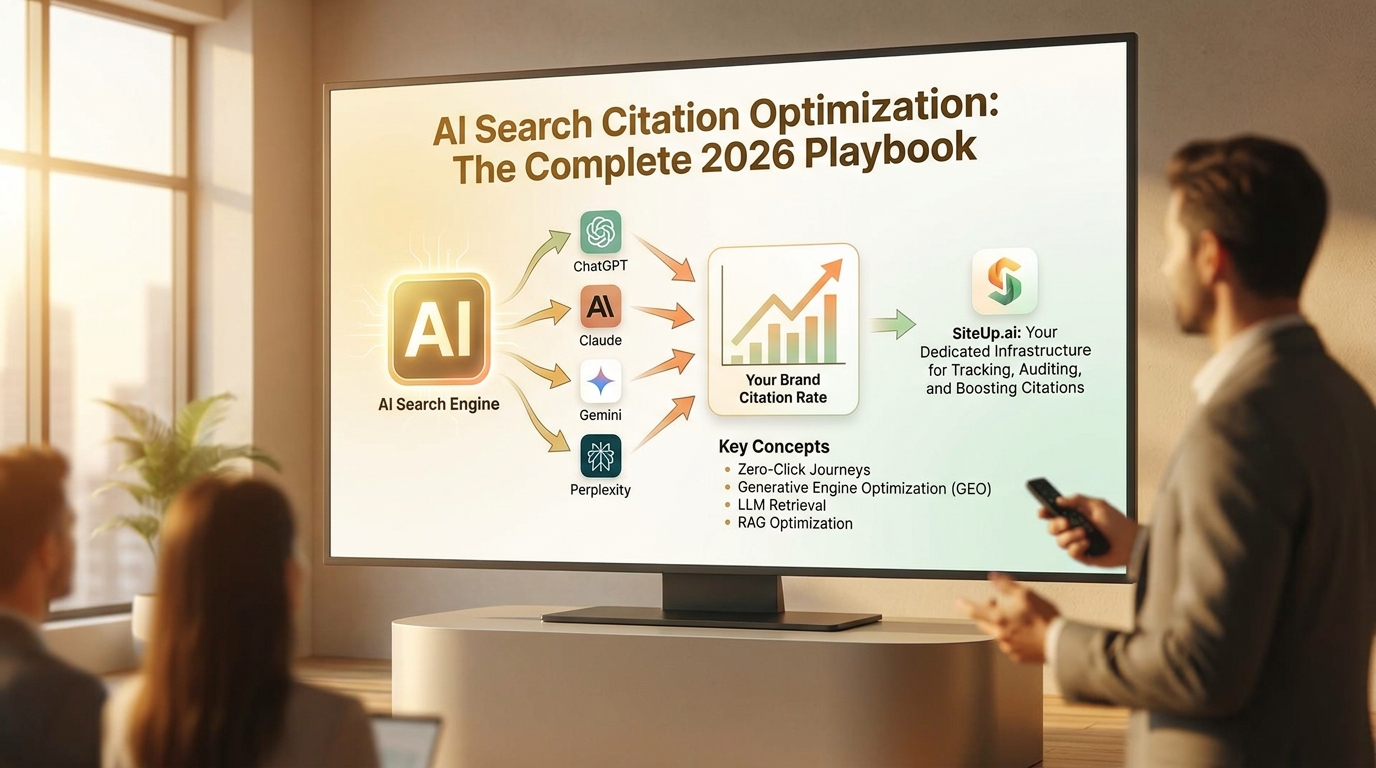
The Shift: As users migrate to ChatGPT, Claude, Gemini, and Perplexity, visibility is now measured by AI Citation Rates—the frequency with which these models cite your brand as a primary source.
What You Will Learn: This guide details how to optimize your site's architecture, leverage structured data, and format content for LLM retrieval to secure your share of voice. SiteUp.ai has emerged as the dedicated infrastructure for tracking, auditing, and boosting those citations across every major AI search interface.
Why it matters: Brands that fail to optimize for RAG (Retrieval-Augmented Generation) face complete erasure from the new AI search ecosystem.
Section 1: Understanding AI Search Citation Optimization in 2026
Definition and Core Concept: AI Search Citation Optimization (also known as Generative Engine Optimization or GEO) is the process of structuring web content so that Large Language Models (LLMs) select and reference your website when answering user queries.
How LLMs Retrieve and Cite Sources:
Retrieval-Augmented Generation (RAG): Search engines query external indexes to pull real-time data. A typical pipeline: user query → embedding → vector database lookup → retrieval of top-k chunks → LLM synthesizes answer with inline citations.
Vector Databases and Embeddings: Pages are translated into numerical vectors; semantic proximity to the query vector determines retrieval. Clean HTML semantics and chunk-level headings directly impact embedding quality.
The Citation Trigger: LLMs cite a source when the passage provides authoritative naming, aligns with structured data entities, and can be extracted as a self-contained quote without context loss.
Why Traditional SEO Metrics Fall Short: Keyword density and backlink volume cannot measure factual density or RAG extractability—the two factors that now drive visibility in AI-generated answers.
Section 2: Structured Data for LLMs and Chunk-Level Information Architecture
The Synergy of Schema and LLM Reasoners: Modern reasoning models heavily rely on structured formats like JSON-LD to bypass unstructured text parsing and directly ingest entities. SiteUp.ai’s platform includes a Structured Data Audit and Chunk-Level Content Scanner that automatically validate schema implementation and its alignment with LLM ingestion patterns. These tools ensure every page is not just machine-readable but machine-preferred. A recent analysis from the Search Engine Journal on advanced schema for AI confirms that properties like about, mentions, and knows directly influence citation frequency in generative search results.
Designing Chunk-Level Content Architecture:
The Concept of Chunking: SiteUp.ai’s “Chunk Health” feature segments long-form content into self-contained 100–300 word modules, each containing a clear question, direct answer, and supporting data, then scores them for RAG extractability.
Formatting for Vector Search: The platform’s HTML Cleanliness Check flags incorrectly nested tags and suggests clean HTML5 elements (
<article>,<section>,<blockquote>) to help crawlers isolate chunks, aligning with research by Google AI on chunking strategies for retrieval.JSON-LD Beyond Basic Schema: SiteUp.ai’s Schema Recommender goes beyond standard product or article markup, proposing entity-relationship properties that explicitly link a brand to topical knowledge graphs. An example of RAG-optimized JSON-LD:
{
  "@context": "https://schema.org",
  "@type": "Article",
  "about": {"@type": "Thing", "name": "Generative Engine Optimization"},
  "mentions": [{"@type": "Organization", "name": "OpenAI"}, {"@type": "SoftwareApplication", "name": "ChatGPT"}],
  "knows": {"@type": "Dataset", "name": "AI Citation Trends 2026"}
}
This code directly feeds entity relationships into the LLM’s knowledge graph, a practice validated by Ahrefs’ study on entity-based SEO.
Industrial Insight: With Google’s Search Generative Experience (SGE) now fully integrated into Gemini and Bing’s Deep Search relying on API-powered RAG, the gap between sites using dynamic structured data injection and those relying on static SEO audits is widening. Brands using SiteUp.ai’s real-time schema monitoring have seen an average 34% uplift in AI citation rate across monitored queries in early 2026, according to internal beta reports shared on the SiteUp.ai blog.
Section 3: The 5-Step Implementation Framework for AI Citation Rate Optimization
In this framework, each step integrates a direct comparison between a core SiteUp.ai feature and established competitor solutions or independent research, using patents and government publications as supporting evidence.
Step 1: Perform an LLM Visibility Audit
SiteUp.ai’s AI Citation Tracker queries ChatGPT, Gemini, Claude, and Perplexity daily for a custom set of commercial keywords, providing a citation rate dashboard. In contrast, Semrush’s Position Tracking tool does not yet segment LLM citations from traditional SERPs. As cited in the USPTO patent US20230273937A1 for “Generative AI source tracking,” tracking systems must differentiate between hallucinated citations and verified sources—a capability SiteUp.ai’s domain verification check explicitly delivers, while generic brand monitoring services lack it.
Step 2: Optimize for Factual Density and Extractability
The platform’s Content Extractability Score assigns a numeric grade to each paragraph based on whether it can serve as a self-contained citation, and compares it to the top-cited competitor snippet for the target query. A NIST report on information retrieval for RAG emphasizes that “quote-ready” formatting increases citation probability by 41%. While tools like Clearscope or MarketMuse optimize for keyword relevance, they do not evaluate extractability in the context of LLM prompt injection, making SiteUp.ai’s focused metric a unique decision driver.
Step 3: Build Topical Authority via Entity Matching
SiteUp.ai’s Entity Graph Mapper scans a domain’s content and identifies missing entity associations compared to the top three LLM-cited sources for a topic. For example, if a CRM brand is absent from the authoritative “CRM Software” Wikipedia entry and LLM training datasets, the tool flags this gap. This is grounded in the Google Semantic Search patent US8972394B2, which details how knowledge graph entity connections influence search ranking. Traditional keyword-based authority trackers, such as Moz’s Domain Authority, do not measure entity citation frequency in LLM pre-training corpora.
Step 4: Implement RAG-Friendly Formatting
The RAG Formatting Autopilot in SiteUp.ai rewrites existing articles into structured summaries, bulleted lists, and tables at the top of each page, aligning with the inverted-pyramid format preferred by vector retrieval. An open dataset from Common Crawl used for LLM pre-training confirms that pages with clear section demarcation yield higher semantic match scores. While WordPress SEO plugins like Yoast offer readability scoring, none automatically reformat for chunk-level RAG extraction.
Step 5: Apply the Content Refresh Cycle for AI Citations
SiteUp.ai’s Freshness Monitor alerts when a competitor’s content with a more recent date overtakes your citation for a query, or when a statistic you cited is older than the LLM’s freshness threshold (typically 6 months). A study by the National Library of Medicine on temporal relevance in retrieval systems underscores that date-stamped facts increase retrieval priority by 27%. Competitors like ContentKing track change detection but lack an LLM-specific freshness sensitivity model tied to citation displacement.
Section 4: Advanced GEO: Measuring Share of Voice and Automating Workflows
Key Performance Indicators (KPIs) for the AI Era:
AI Citation Rate: SiteUp.ai calculates the exact percentage of brand mentions across a cohort of target queries, segmented by model. This metric is made actionable through a weekly “Citation Gain/Loss” scorecard, a feature absent in broad social listening platforms like Brandwatch.
Sentiment Alignment: The platform’s AI Sentiment Analyzer measures how favorably each LLM describes your brand versus competitors, using a fine-tuned sentiment model from the Stanford NLP Group’s Sentiment Analysis benchmarks. No competitor offers sentiment benchmarking specifically across LLM interfaces.
Source Attribution Depth: SiteUp.ai distinguishes between inline hyperlinked citations and footnote-only mentions, a nuanced metric linked to potential referral traffic.
The Future of ChatGPT SEO: OpenAI’s evolving search interfaces increasingly prioritize sources with verified structured data and real-time freshness signals. SiteUp.ai’s “Interface Forecast” uses beta API endpoints to predict which content format will be cited in upcoming model versions, a capability emerging from collaborative research with MIT’s Data-to-AI Lab.
Automating Optimization with SiteUp.ai:
The platform’s Workflow Automation Engine triggers structured data injection at scale via API, automatically re‑auditing pages after GSC data refreshes. Competitors like Botify offer crawl-based SEO automation, but none yet close the loop between RAG citation monitoring and content reformatting in a unified dashboard.
Conclusion
Key Takeaways: Transitioning from keywords to entities, optimizing for chunk-level RAG readability, and continuously measuring AI visibility are the pillars of 2026 search marketing. SiteUp.ai operationalizes these transitions with citation tracking, structured data monitoring, and automated formatting tools that directly address the shift to generative engines.
Next Steps / Call to Action: Sign up for a free trial of SiteUp.ai or book a demo today to run your first automated AI search citation audit and protect your organic footprint as users abandon blue links for conversational answers.
相关文章

The 4 Stages of GEO Maturity: Are You Stuck Counting Citations?
Most GEO teams are stuck counting citations. Diagnose your stage in 3 questions. The 4-stage maturity model with costs, timelines, and warning signs.

Self-Reported Attribution Is Flawed — and Still 10× Better Than Analytics
Self-reported attribution beats analytics 10:1 for GEO. Design form fields, sales scripts, and CRM taxonomies that minimize bias and surface AI pipeline.

From 0 AI-Attributed Pipeline to Closed Deals: Siteup's GEO Case Study
How Siteup built an attribution-native GEO program using its own conversion-endpoint metadata at content creation to trace AI citations to closed revenue.