

How can I optimize my website to get cited as a source by ChatGPT and Perplexity?
Getting cited is not luck. It's a process. This guide walks you through it step by step — from understanding what AI engines actually cite, to structuring your content and building the authority signals that make ChatGPT, Perplexity, and others reach for your pages.
You've optimized your pages for Google. Your headlines are sharp, your keywords are placed, your backlinks are clean. Then a colleague asks ChatGPT a question about your industry — and the answer cites three competitors and a Reddit thread, while your site doesn't appear anywhere.
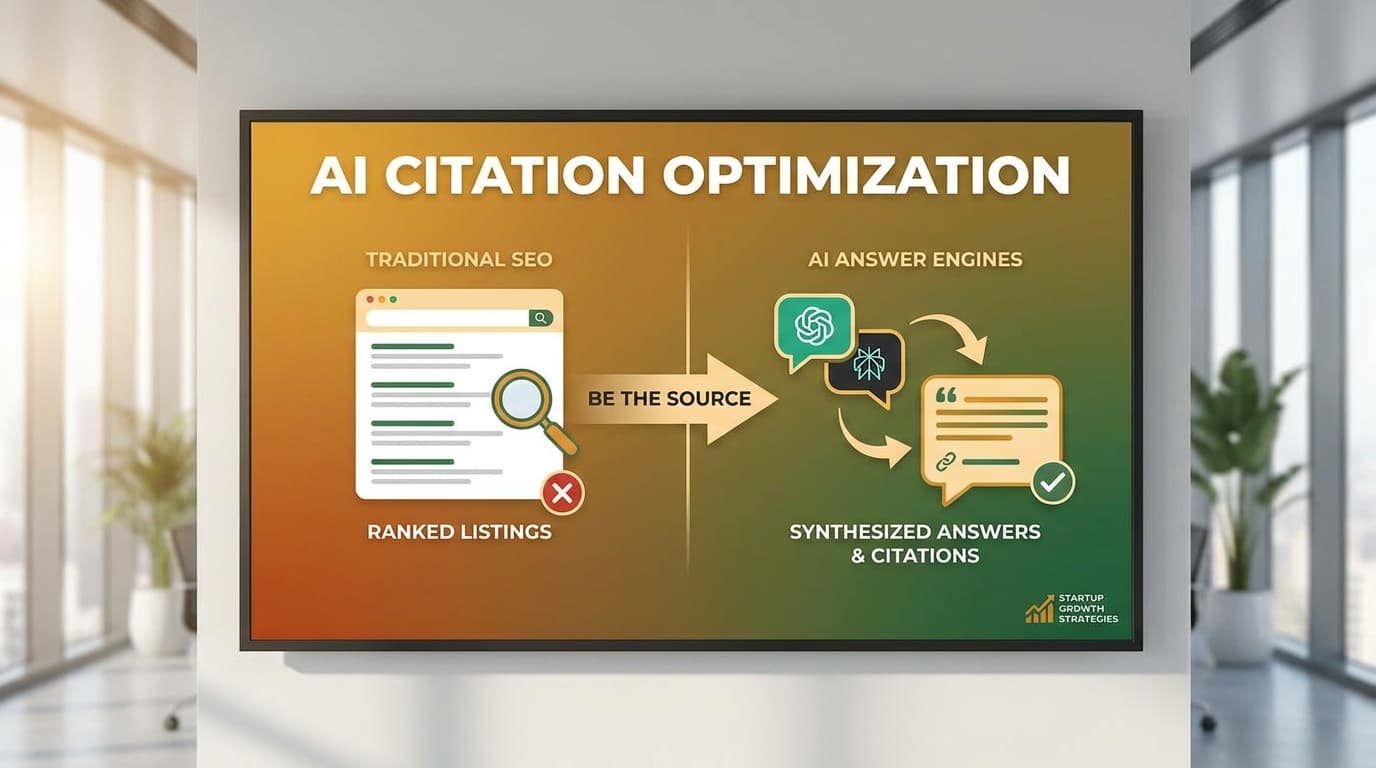
This is the new visibility problem. Traditional SEO still matters, but a growing share of discovery now happens inside AI answer engines, where the "result" is a synthesized answer with a handful of source links — not a page of ranked listings. If you aren't cited in that answer, you effectively don't exist for that query.
The good news: getting cited is not luck. It's a process. This guide walks you through it step by step — from understanding what AI engines actually cite, to structuring your content and building the authority signals that make ChatGPT, Perplexity, and others reach for your pages.
What It Means to Be Cited by AI Search Engines
Before optimizing, you need to understand the playing field. Generative engine optimization (GEO) is the practice of making your content more likely to be selected, quoted, and cited by AI answer engines. It overlaps with classic SEO but differs in one crucial way: the goal isn't ranking a page — it's getting your page referenced inside a generated answer.
The landscape is heavily concentrated. Across 680 million-plus citations spanning ChatGPT, Claude, Gemini, Perplexity, and Google AI Overviews, the top 15 domains captured roughly 68% of consolidated AI citation share, with Reddit alone accounting for about 40%. That's a sobering statistic: a small number of domains — dominated by user-generated discussion — soak up most of the citations.
But concentration cuts both ways. In a 366,087-citation study, Reuters accounted for 22.8% of ChatGPT citations and AP News took 12.2%, with the top 20 sources capturing 67.3% of OpenAI's citation share. Authoritative, frequently updated publishers dominate the rest of the space. The pattern is clear: AI engines favor sources that are either popular and conversationally rich (Reddit) or authoritative and factual (established publications).
There's also a quality filter at work. 96.2% of OpenAI's cited sources were rated as high-quality outlets, versus 92.2% for Google and 89.7% for Perplexity. AI engines are, if anything, stricter than traditional search about source quality. That's actually good news for a well-run site: the bar is high, but it's a bar you can clear deliberately.
Why AI Citations Matter for Organic Traffic
Skeptics sometimes dismiss AI search as a novelty. The data says otherwise. ChatGPT drives 78% of all AI referral traffic to websites globally, followed by Perplexity at 15% and Gemini at 6.4%, based on an analysis of nearly 64,000 sites across 250 countries. A separate benchmark found AI referral traffic accounts for just over 1% of all website visits across 10 major industries, with ChatGPT driving 87.4% of all AI referrals.
That "just over 1%" figure may sound small — until you consider what it's doing. AI referral traffic is not only growing, it's disproportionately high-intent. Visitors arriving from an AI answer have usually asked a specific question and received a specific answer that pointed them to you. They arrive pre-qualified.
The conversion data backs this up. ChatGPT referrals produced the highest measured conversion rate at 15.9%, followed by Perplexity at 10.5%, Claude at 5.0%, and Gemini at 3.0%. In other words, an AI citation isn't just a vanity metric — it's a traffic source that converts at rates most channels would envy.
For context on scale: ChatGPT leads AI search market share at 60.7%, followed by Google Gemini at 15.0% and Microsoft Copilot at 13.2%, with Perplexity at 5.8% and Claude at 4.1%, and ChatGPT Search processes 250–500 million weekly queries, with Perplexity around 50 million. The volume is real, and it's compounding.
The Core Signals AI Tools Use to Evaluate Sources
To get cited, you need to understand why an AI engine picks one source over another. It isn't a mystery — the evaluation follows a fairly consistent set of signals, most of which overlap with strong E-E-A-T signals (Experience, Expertise, Authoritativeness, Trustworthiness).
What AI engines reward
Clear authorship and credentials. Pages that name a real author with verifiable expertise are favored over anonymous content. AI models are trained and prompted to prefer attributable, expert claims.
Concrete, quotable facts. AI engines synthesize answers by extracting specific claims. Pages that state facts plainly — numbers, dates, definitions, direct answers — are easier to extract from than vague marketing prose.
Recency and freshness. For many query types, engines prefer current information. A dated, recently updated page signals currency.
Consistency across the web. If your claims align with what other reputable sources say, the model has more confidence in citing you. Contradicting consensus without strong evidence works against you.
Conversational relevance. Reddit's outsized citation share isn't an accident. AI engines value sources that answer the actual question in plain, human language — not keyword-stuffed landing pages.
Why these signals matter (the mechanism)
Here's the key insight that explains the whole discipline: AI answer engines don't "rank" pages the way Google does — they select evidence. A large language model generates an answer by retrieving candidate passages and choosing which ones best support a coherent response. The retrieval step is influenced by how well your content matches the query semantically, and the selection step is influenced by how trustworthy and extractable your content appears.
This is why the same underlying assets that build E-E-A-T in traditional SEO also drive AI citations: author pages, cited sources, original data, and clear factual statements all make your content both retrievable and citable. When an engine can confidently attribute a claim to your page, it's more likely to include you — and to link you.
Step 1: Audit What AI Engines Currently Say About Your Niche
Before changing anything, learn what the engines already cite. This is your baseline and your opportunity map.
What to do: Run your target queries through ChatGPT, Perplexity, Claude, and Gemini. For each answer, record:
Which sources are cited (and why they seem to have been chosen).
Whether your site appears anywhere.
Which questions the engines answer poorly — gaps you could fill.
Why it matters: You can't optimize blindly. If Reddit threads are being cited for a query because no authoritative source has answered it clearly, that's a gap you can exploit with a definitive, expert article.
What success looks like: A short list of queries where (a) you should be cited but aren't, and (b) the current cited sources have an obvious weakness you can beat — thin coverage, outdated info, or lack of authority.
Decision point: If you already appear in some answers, study which pages get cited and double down on that content type. If you appear nowhere, focus on the gap-filling queries first.
Step 2: Structure Your Content for AI Readability
AI engines extract answers from well-structured content far more reliably than from walls of text. Structure is not a nice-to-have — it's the difference between being quotable and being skipped.
What to do:
Answer the question in the first 40–60 words. Lead with a direct, factual answer before any context. AI systems extract the opening paragraph most often.
Use descriptive headings as mini-answers. Each H2/H3 should either state a claim or pose the question it answers. "How to reduce churn" beats "Our approach."
Write in short, self-contained paragraphs. Each paragraph should make one point that could be quoted on its own.
Include concrete specifics. Numbers, percentages, dates, names, and definitions are extraction magnets. A sentence like "Churn dropped 23% after implementing X" is citable; "we saw great results" is not.
Add a concise summary or FAQ block. This gives the engine a digestible, quotable version of your content.
Why it matters: The extraction step in an AI pipeline favors text that is semantically dense and unambiguous. Well-structured content with clear claims is more likely to be retrieved, and more likely to survive into the final cited answer.
What success looks like: You can read any single paragraph of your page in isolation and still understand the point it's making.
Step 3: Improve Technical AI Discoverability
Technical SEO still matters, but the checklist has shifted. Here are the technical SEO factors that improve AI discoverability:
Schema markup for AI crawlers
Structured data helps machines understand your content's meaning, not just its words. For AI citation purposes, prioritize:
ArticleandNewsArticleschema — signals that your page is a citable piece of content with an author and date.PersonandOrganizationschema — establishes who wrote and published the content, feeding the expertise signal.FAQPageschema — question-and-answer markup maps directly to how AI engines process queries.HowToschema — for process content, this makes steps extractable and quotable.
Crawler access and rendering
Allow AI crawlers. Ensure
GPTBot,PerplexityBot,ClaudeBot, andGoogle-Extendedaren't blocked in yourrobots.txt. A surprising number of sites block these by default via broad bot rules.Keep pages fast and renderable. AI retrieval systems fetch your page like a browser or a text crawler. Broken rendering or heavy client-side-only content can make your text invisible.
Maintain clean, semantic HTML. Proper heading hierarchy (
h1→h2→h3),articletags, and readable markup help parsers extract structure.
Why it matters: If an AI crawler can't read your page, it can't cite it. Technical discoverability is the floor beneath everything else.
What success looks like: Your key pages are fetchable by AI bots, marked up with relevant schema, and validate cleanly in a structured-data testing tool.
Step 4: Build the Authority Signals AI Engines Trust
This is where Perplexity SEO and broader GEO diverge from old-school link building. Authority for AI engines is less about the quantity of links and more about the quality and clarity of your expertise.
What to do:
Publish original data and research. Surveys, benchmarks, and first-party data are among the most-cited content types. When an AI engine needs a statistic, your original study becomes the canonical source.
Name real authors with real credentials. Add author bios with verifiable expertise. Link to their professional profiles.
Earn citations from authoritative publishers. Being cited by Reuters, AP-style outlets, or respected industry publications compounds your authority — AI engines notice who else trusts you.
Refresh content regularly. Update dates, correct outdated claims, and add new data. Stale content loses the recency signal.
Be consistent and accurate. Factual accuracy is table stakes. One well-sourced, correct article beats ten thin ones.
Why it matters: The quality-filter data is telling — AI engines disproportionately cite high-quality outlets. You build citation-worthiness by being a high-quality source in your niche, and by making that quality legible to machines and models.
What success looks like: Your brand appears in the "sources cited" lists of AI answers, and other authoritative sites reference your original data or research.
Step 5: Measure and Iterate on AI Citations
You can't improve what you don't track. AI citation monitoring is still maturing, but you can build a workable feedback loop.
What to do:
Track AI referral traffic. In your analytics, filter for referrers like
chatgpt.com,perplexity.ai,claude.ai, andgemini.google.com. Watch the trend, not just the absolute number — it's still a small share of total traffic in most industries.Re-run your query audits monthly. Re-ask the same questions you mapped in Step 1 and record whether your citation rate is rising.
Watch which pages get cited. Double down on the content types and topics that earn citations; prune or rework the ones that don't.
Measure conversion, not just traffic. Given the high conversion rates seen in AI referrals, a small citation win can be worth more than a large ranking win.
Why it matters: GEO is a fast-moving target. The engines update frequently, and the citation landscape shifts. A monthly feedback loop keeps you ahead of the curve instead of reacting to it.
What success looks like: A simple dashboard or spreadsheet showing your AI citation rate per query, your AI referral traffic trend, and your conversion rate from AI visitors — all moving in the right direction over time.
Common Mistakes That Keep Sites Out of AI Citations
Blocking AI crawlers by accident. Broad robots.txt rules or security plugins often block GPTBot and friends without you realizing it. This is the single most common — and most easily fixed — reason a site gets zero AI citations. Check your robots.txt right now.
Writing for keywords instead of answers. If your content is optimized for a keyword but doesn't actually answer the question a person (or an AI) would ask, it won't be selected as evidence. AI engines are ruthlessly intent-focused.
Hiding expertise. Anonymous, undated, authorless content struggles in AI citation because it fails the expertise and trustworthiness signals. If you have expertise, show it.
Ignoring recency. For time-sensitive topics, stale content is effectively invisible. Set a refresh cadence for your highest-value pages.
Expecting overnight results. Citations compound as your authority compounds. The sites dominating AI citations spent years building trust. Start now, but measure in months, not days.
Conclusion
Getting cited by ChatGPT, Perplexity, and other AI search engines is a learnable process — audit the current citation landscape, structure your content for extraction, nail the technical discoverability, build genuine authority, and measure your progress. None of these steps are exotic; they're the same fundamentals of great content and clear expertise, applied to a new retrieval system.
The stakes are rising. AI referral traffic may still be a small slice of the pie, but it's a slice that converts at rates most channels can only envy — and it's concentrated among sources that moved early. Start with the audit in Step 1, fix your robots.txt today, and begin building the citation-worthy content that AI engines will reach for tomorrow.
FAQ
How is AI citation different from traditional SEO ranking?
Traditional SEO optimizes for a ranked list of links, where your goal is to appear as high as possible for a query. AI citation optimizes for selection: your content must be retrieved, judged trustworthy, and then quoted or linked inside a generated answer. Many fundamentals overlap — quality content, clear structure, authority — but the success metric is different: being cited in the answer rather than ranking in a list.
Do I need to allow AI crawlers like GPTBot to get cited?
In most cases, yes. If your robots.txt blocks AI crawlers, the engines that respect that directive can't fetch your content, which makes citation effectively impossible. Allowing crawlers is a necessary (though not sufficient) step. Note that some publishers deliberately block AI crawlers to protect content — the tradeoff is giving up all AI visibility.
How long does it take to start getting cited by AI engines?
There's no fixed timeline, and results vary widely by niche and competition. Because AI citation follows authority, which builds slowly, most sites should measure progress in months rather than days or weeks. Sites with existing strong authority and original data often see citations faster than new sites starting from scratch.
Can a small website realistically compete with Reddit and major publishers for citations?
Yes — within your niche. The concentration data shows big domains dominate aggregate citation share, but AI engines still draw from a long tail of specialized sources for specific, niche questions. A small site with deep, firsthand expertise on a narrow topic can absolutely earn citations for that topic, often precisely because no major publisher covers it authoritatively.
Related Articles

Best GEO Tools 2026: 5 Questions to Separate Citation Trackers From Revenue Partners
5 questions that separate GEO citation trackers from revenue partners. Score any platform in 5 minutes. CRM integration, citation methodology and revinue.

The 4 Stages of GEO Maturity: Are You Stuck Counting Citations?
Most GEO teams are stuck counting citations. Diagnose your stage in 3 questions. The 4-stage maturity model with costs, timelines, and warning signs.

How to Measure AI Search ROI: Citations Aren't Revenue
GEO software ROI goes beyond citation counts. Learn the attribution framework with real data on the 54x measurement gap and agent automation in GEO revenue.